Showing posts with label acid. Show all posts

Monday, June 22, 2015

Understanding the Significance of the pH scale and the phenomena of Osteoporosis


Life began in the sea, and as such, all living things contain water and function in an aqueous space. It is possible to observe an internal ocean within the cell and an external ocean encompassing the cell. Water's simple molecule - two hydrogens bonded to an oxygen - provides the space and plane for the molecular and biological world to move around and to carry out its life functions. Digestive enzymes cannot reach and carry out the mining of the raw materials without an aqueous space, which provides them the room to maneuver in order to transport nutrients to the absorption cells. Furthermore, the bloodstream is 90% water, because water makes it possible for nutrients to drift on the River of Life and to hydrate any dehydrated cells, while stripping the waste and transport it to the liver.

Why is it important to develop appreciation to water? We'll explore water's importance and the influence of substances on its pH. We'll examine the reason for the development of tissue calcification and the phenomenon of Osteoporosis, as well as, which foods can return the body to its original and healthy pattern.

Tuesday, August 19, 2014

The ART of Soaking Nuts and Seeds

Prior to the agricultural revolution man had lived in a state of hunting and gathering, much of which is still seen in tribal cultures tucked away far from public interaction. Like the Kitava, studied by Staffan Lindeberg, who live in perfect health and live long lives. The Paleo diet, coming from the word Paleolithic, describes a type of diet that man had prior to the agricultural revolution, prior to the point in our history that introduced grains and legumes and forced man to work the earth. 

Wednesday, February 20, 2013

Extracellular Defense System Overview


This is the most important system to take care of, and on a daily basis.
  • Probiotic bacteria sequester Opportunistic bacteria (pathogenic) by secreting antibiotic-type chemicals (only when probiotic populations is larger then pathogenic).
  • Probiotic bacteria relief malnutrition, as they eat our food and poop and pee out minerals and vitamins. Pathogenic bacteria secrete toxins, which harm our own cells. 
  • Probiotic bacteria enhance function of the immune system. They maintain an environment that is suited for immune cells to thrive.
Why should I care?
We can observe from the many studies over the last 30 years that probiotic bacteria complete and definitely uphold a 'health cycle'. If we categorize all the defense systems of the body, we observe that there is a cellular one (immune system protecting cellular environment) and a molecular one (antioxidants neutralizing free radicals). These require building blocks, which probiotic bacteria enhance from our diets, but pathogenic bacteria that secrete toxins cause stress on these cells and empty their defenses. Simply, taking care of your bacterial population dramatically alters disease.

If you control the food, you control the population.
Some type of food actually feed bad bacteria, while other types exclusively feed beneficial bacteria. Just like roots of a tree has an ecosystem of bacteria, so do you. Our roots are internal, so you can imagine the gut as a root system designed to absorb nutrients and the bacteria help this process thrive... well, actually, they make it happen. This is an evolutionary symbiotic relationship; the human body has a forgotten organ that coats the entire digestive tract; from the mouth to the anus. A fine coat of bacteria. But the population is affected directly by food consumption; Sugar and complex carbohydrates feed bad bacteria, while vegetables and some fruit feed beneficial bacteria.


Bacteria are one of the oldest organisms on the planet. They are single cell organisms without a nucleus, aka prokaryotes, and certain species have evolved to produce oxygen by consuming carbon dioxide. The bacteria are the cause for the rise in oxygen in the atmosphere millions or even billions of years ago. This rise in oxygen accompanied an evolution of another bacteria into a new species, of which had made a remarkable effect on organism patterns and life. This species of bacteria, like the Mitochondria, made their way into a community of other bacteria to form a Eukaryotic cell; an evolved cell with the capacity to adhere to other cells of the same nature. Thus a multicellular organism evolved.

What can definitely be described as next to happen was formation of a multicellular organism; tissue by tissue, organ by organ, forming a community of cells that specialize in a task for the great good of the whole. However, as the multicellular organism developed a community of over a trillion adhering cells, bacteria remained the ancestors of us all and they remain to this day a part of the multicellular organism's ecological system.

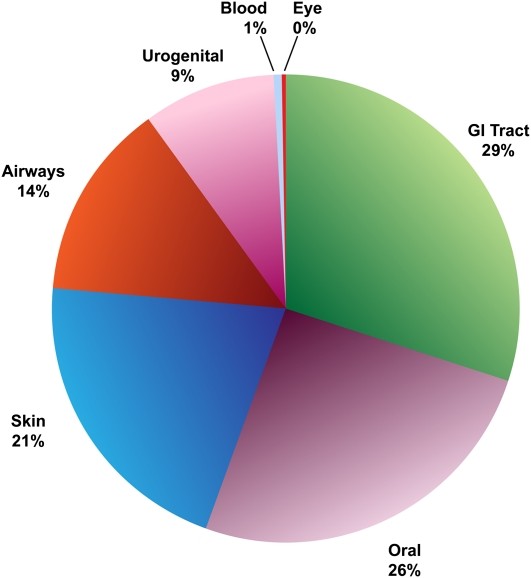
There are 10 times more bacteria on the human body, then human cells. If we have approximately 1 trillion cells; from brain cells, skin cells, liver cells, heart cells, gut cells, muscles cells etc., you will find 10 trillion bacteria on and in the body. Now, you cannot find them in the blood or on your eyes, as the body keeps those zones sterile for the function of the system (immune cells etc.). However, in some cases bacteria find their way in, usually after an injury or consumption of food that promote a leaky gut (i.e. grains). On the right is a pie chart representing the percentage of bacteria you can find in and on your body [taken from here].

As you can deduce from the chart, bacteria are only present on surfaces that are in contact with the outer world, and the largest percentage is in the gastrointestinal tract (29%). Nevertheless, bacteria can be found in other areas as well, and may very will be connected to that areas healthful state.

Dysbiosis
A condition of imbalance in microbial populations on or in the body is called Dysbiosis. The germ fear in the beginning of the 1900 century brought many of the public to believe that bacteria are only pathogenic. Many people lack the knowledge that there are probiotic bacteria, and many who have heard of probiotic bacteria lack the perspective on the depth of their importance to the physical-biological body's health. They are our Extracellular Defense System, and I will cover why and how.

Pathogenic bacteria, like probiotic bacteria, seek food for them to nourish and reproduce. Some pathogenic bacteria can thrive on free sugar in the diet, others make the effort to harm the host's cells in order to thrive on minerals like iron. Bacteria are everywhere, also found in radioactive tanks, where people presumed life could not exist.

These pathogenic bacteria are harmful for the functionality of many organs, like the stomach; where Helicobacter Pylori has been observed to destroy parietal cells in charge of producing a specialized enzyme called Intrinsic Factor. This enzyme is responsible for transporting B12 across the gut lining into the bloodstream. Adults and children with this infection suffer from B12 deficiency, even when they take supplements or eat a B12-rich diet[1][2]. A probiotic supplementation resolved this issue[3].

On the other hand, probiotic bacteria essentially protect the cells from increasing pathogenic bacteria populations by secreting antibiotic chemicals, that inhibit competing bacteria. This is also achieved inversely; pathogenic bacteria can inhibit probiotic bacteria. This is accomplished by the population size - the bigger the population the stronger their effect on the competing species.

Control the Food and you Control your Health

Population has always been controlled by food, and there lays the cause for pathogenic bacteria overthrow of probiotic species. For example; a cow consuming a grain diet develops a dominant species of E. Coli and a specific harmful strain (Escherichia coli O157:H7) that thrives on the complex carbohydrate diet supplied by the grains, and as a by product they expel toxins and methane gas[4]. This causes severe inflammation in the cow's complex gut system (rumen), which impairs their health and their value of parts and by products they produce for the industry. However, it only takes 5 days on an evolutionary diet of grass (i.e. grass-fed diet) to observe a 1000-fold decline in the E.Coli population[5].

Could the same effect happen to humans? I see why not. A biological system is a biological system, and probiotic bacteria are part of this ecological system that is the human physical body.

Lets observe a case of a human trial published December 13rd, 2012[6]. An obese person is found to contain a pathogenic bacteria strain called Enterobacter, that composed 35% of the gut microbial composition and is observed to secrete endotoxins that cause inflammation in the gut's environment. After 23 weeks on a diet of whole grains, traditional Chinese medicinal foods and prebiotics, the strain of bacteria was reduced to "non-detectable" levels, "during which time the volunteer lost 51.4 kg of 174.8 kg initial weight and recovered from hyperglycemia and hypertension". 

Food that Strengthen your Probiotic Population

Now, prebiotics are food that contain resistant starch, usually a complex carbohydrate called Inulin, that is present in many vegetables and some fruit, and it exclusively feeds probiotic bacteria[7]. These are food like Raw Chicory root with 64.6% inulin (highest content), Raw Jerusalem Artichoke (31.5%), Raw Dandelion Greens (24.3%), Raw Garlic (17.5%), Raw Leek (11.7%), Raw Onion (8.6%), Raw Asparagus (5%), Cooked Onion (5%) and Bananas (1%)[8][9]. Though, cacao has also been found a prebiotic[10] and it's medicinal effects are vast (but sugar harms it's medicinal properties[11]).

The list of benefits from probiotic bacteria is long

Some strains produce B vitamins(including B12[12] and B9[13]), some produce precursors to CoQ10, some inhibit toxins and heavy metals. Like I said, the list is long. What is evident, is that these probiotic bacteria live in a symbiotic relationship with the biological organism. The soil in the ground is a biodiversity of bacterial organism, that break down materials and makes minerals available for the plant to uptake through their roots. Same thing applies to humans or any other animal (like a cow and it's rumen), these probiotic bacteria digest plant matter and release the contents of cells that our gut cannot digest on its own. 

These probiotic bacteria are our Extracellular Defense System and secondary digestive system. We require them to not only to break down food our gut is unable to, but to protect the inner environment (gut, mouth and airways) and outer environment (skin) clean of pathogenic bacteria. Since about 80% of your immune system is in your gut, taking care of the gut environment is crucial for a functional immune system in that area. Lactobacillus bacteria produce Lactic acid, that makes an environment favorable for immune cells. Lactate, from lactic acid, has also been observed to be the preferred energy source of neurons (brain cells), unlike what was previously thought was only glucose[14].

If you get a flu or cold, and your body is fighting off an infection, then you certainly have a condition of bacterial imbalance (Dysbiosis) and that means you were eating something that favored the disease causing bacteria, and now all you need is to eat something that favors the pro-life bacteria. You can also simply eat fermented food, like Sauerkraut, Kimchi and more.

You can hear an interview of Dr. Natasha Campbell-McBride by Dr. Joseph Mercola (from Mercola.com). She is considered the authority in all that has to do with probiotic bacteria, as she has written a book called GAPS (Gut and Psychology\Physiology Syndrome) where she details her cases of curing many diseases by placing patients on a strict protocol. 

For further literature, I suggest reading this webpage: Probiotic bacteria: What are they? | Probiotics Help

For further articles of mine touching upon this subject, check out these following articles:
Books Worth Reading (A book called Gut and Psychology Syndrome)
The Bacterial Entity and the Hunger for Connection


Restore your Confidence in Fat

You can get twice the calories per gram from fat than you can from proteins and carbohydrates[1]. Each cell in our body has a membrane that is composed 50% of fatty acids and cholesterol[2], which give it all its wonderful attributes. A grand design that is certainly built upon natural selection, and heck, it worked for millions of years. Now, interestingly, humans are consuming food that numbs their brain and so they neglect to appreciate and look back at how their ancestors maintained perfect health for hundreds of thousands of years, even in the face of ice ages.

Prior to World War 2 it has been established in the medical community that Grains, Legumes, Milk and Sugar causes obesity, and to lose weight your doctor would advise you to refrain from all of these foods[3]. Prior to the advent of agriculture, approximately 12,000 years ago, human beings were eating lean meat, fish, eggs, vegetables, fruits, roots, nuts and seeds, seasonally and fresh (plus everything was organic). What happened post WW2 that changed this established guidelines completely?

The major cooking and baking oil used in the United States, prior to WW2, was coconut oil. However, the Japanese conquered the Philippines and halted the export to the US, considerably reducing the supply of this desired commodity[4]. The US government wanted to solve this problem for the American consumers nationwide and turned to their scientists to come up with a solution. The industry at the time developed a method of extracting and converting grains, like corn, into oil, in a processed called Hydrogenation. Since Saturated Fat was a desired structure, because of the constituent fatty acids composing the oil are stable, this method would aspire to transform a liquid like corn extract into a more saturated state by adding hydrogen atoms to its fatty acid structure.

In order to sell these inventions, the food industry spent millions of dollars to advertise their products. When WW2 ended, and in fear of losing millions of spent money on the research, manufacturing and advertisement of these unsaturated oils, they stepped up their campaign and demonized coconut oil while lionizing corn, canola, sunflower and safflower oils. Their strategy included lobbying scientists to tell the media a story and stick to it for as long as they can. Ancel Keys had become a prominent scientist after he presented an epidemiological study[5], where he carefully cherry picked his data in order to support a hypothesis that earned his face on the cover of time magazine. His hypothesis has received plenty of criticism[6].

The Lipid Hypothesis stated that Heart Disease was caused by cholesterol forming a plague in your arteries, and that this cholesterol comes from saturated fat. Therefore, saturated fat is the culprit. However, this hypothesis has never been proven correct, as every single study was actually pointing in the direction of plague formation by oxidation of LDL particles. The fatty proteins (LDL), which carry cholesterol from the liver, through the blood stream, to an area of inflammation, is now considered essential, because cholesterol acts as a bandage. Then the rise of cholesterol in the blood stream is an indication for something else driving this disease, rather then the direct cause.

Anyway, the food industry has been backed by the health industry, as many people going to medical school are taught to believe in the Lipid Hypothesis and the rest of the nation is fed it through the mainstream media industry. 

The real story being uncovered as the culprit in heart disease and arteriosclerosis has to do with malnutrition and consumption of unstable food.

Homocysteine has been found to irritate the lining of the blood vessels, inducing inflammation, which in turn cascades a mechanism that involves shipment of cholesterol to the inflamed area to bandage the fatty membranes of cells harmed by this irritant. Dr. Kilmer S. McCully was the first to propose the homocysteine theory of cardiovascular disease[7], and is the author of the book, The Homocysteine Revolution. His theory was received with great excitement, but in the 70's he lost his job and spent 2 years looking for one, later discovering he was placed on a blacklist.

Homocysteine is a transition compound between synthesis of amino acid Methionine into Cysteine and vise verse. This process requires vitamin B9 and B12, but deficiency in either slows the conversion rate and increases homocysteine levels in the blood stream[8].

Glucose has been observed to oxidize LDL particles[9]. Simple sugars are toxic in the blood stream, and to combat this effect the pancreas secretes Insulin, whom is in charge of signalling cells to intake glucose, and once the cells are satiated, Insulin converts the sugar into fat for storage in fat cells. Insulin has also been observed to switch off the livers mechanism of converting proteins into glucose for energy[10]. Since animal proteins and fats were a great source of stable energy for about 2 million years, the switch to direct intake of glucose disrupts our energy conversion of meat and instead we experience a sharp glycemic load that harms our arteries and drives our weight up.

Now, remember, grains are complex carbohydrates, which means that they are long chains of simple sugars attached together to form a complex structure. This takes longer for the body to break down, therefore their effect compared to refined sugar isn't as immediate. Our digestive tract is designed to break down fats and proteins[11], and so grains are digested and fermented by bacteria in the gastrointestinal tract. You can get a high glycemic load from consuming white bread and whole bread, though whole bread has extra fiber that slows the absorption of the sugar molecules into the blood stream.

Malnutrition and exposure to sugars, whether refined or complex, are the underlining cause of heart disease. Intake of saturated fat has been observed to increase the quality of LDL particles[12] and increase HDL in the blood stream[13]

Coconut Oil as a Cure
Coconut Oil is 90% saturated fat. 50%[14] of that saturated fat is a fatty acid called Lauric Acid, which has been observed to convert easily in the liver to quick and available energy[15], due to its medium length chain structure, as well as have anti-bacterial[16], -viral[17] and -fungal[18] properties. Extra Virgin Coconut Oil also has phenolic compounds that have been observed to have antioxidant capacity[19].

Imagine supplying your body with this saturated building block. If your cells are coated mainly by fat, and coconut oil has been found to heal acne[20], then would you deduce that cells use saturated fat as a quality building block for their cell's wall? Note, that they also observed how a low-carbohydrate diet is correlated with improvement of acne[21]

Essentially, your cells can have a better armor if they have the right fatty acids incorporated in their membranes, i.e. saturated fats. Though, a health cell membrane has also monounsaturated fats, like from olive oil, and polyunsaturated fats, like omega 3 and 6. However, because of the unstable nature of polyunsaturated fatty acids, you want to consume less of them but still maintain a ratio of approximately 1:1. Our brains developed because we ate animal meat and fish high in omega 3, where plant matter was a bit more difficult to do.

In conclusion
Our ancestors developed their intellectual capacity from consumption of fat, that evidently attributed the development of higher communications essential for constructing an intricate civilization. Fat is a great source of energy and meat has always been a condense source of this nutrient. For our cell wall health, fat and cholesterol are the main constituents, while protein makes up 70% of the dry matter of the cell.

The agenda to sell a certain oil has driven the industry to confuse the public for mere money. People are suffering from neurological disorders because of their lack of stable-saturated fatty acids in their diets. Coconut oil is making a big return, and fascinatingly enough, in the Philippines they use it as well as a source of fuel for their cars[22].

We run better on fat, that's a fact. 
Fat doesn't make you fat, that's a fact.

You have a fathead, as Tom Naughton explains in his documentary Fathead.

It is your responsibility to take care of your cells, by supplying them their building blocks. Your nutrition is essentially their nutrition. You can only protect your cells and their organelles by eating an evolutionary, organic, seasonal and fresh diet.

The Responsibility is in your hands.
To your health!